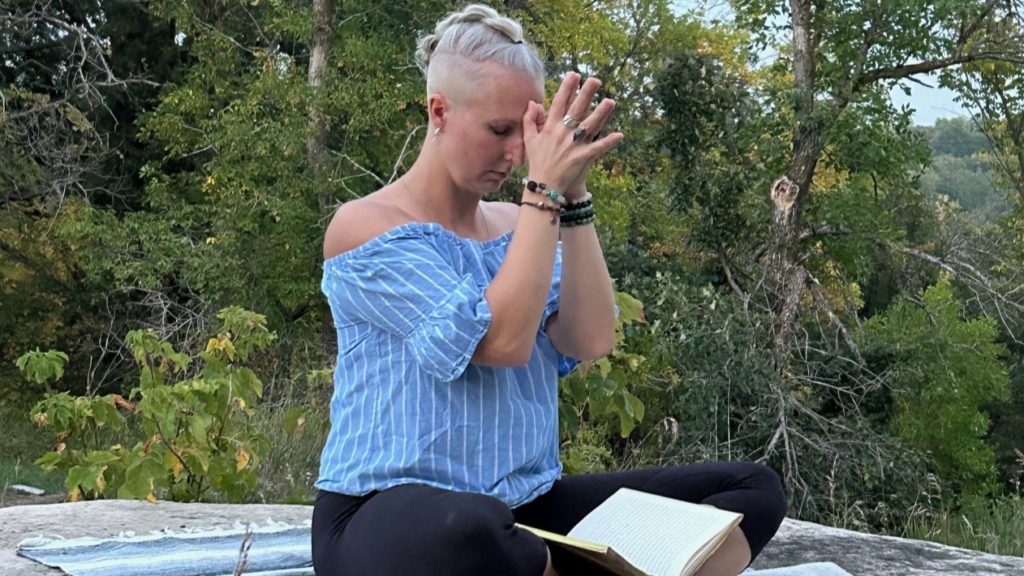
YOGA IS NOT A RELIGION! Louder for those in the back? There. Now that we got that out of the way, let me begin…
My first attempt at explaining the practice of yoga which, to me, feels like trying to encompass everything about living a life, in a language that does not have enough words to cover it.
In our Western society, we tend to think of yoga as something we practice for exercise and flexibility. Often we do this in routine – one, two, or however many times per week as needed. We know some classes will include some chanting, maybe some breathwork, and we pick and choose classes that feel the most comfortable to us. Most of the time, we are familiar with ending class with a final savasana, maybe add in a little guided meditation or visualization so that we leave class feeling more grounded and better prepared to tackle all the things.
But yoga is more than that. Yoga is a lifestyle; a life philosophy. It is not just about putting yourself into the most bendy and twisty poses you can. It’s not about wearing the cutest yoga gear available or looking a certain way. It’s not even about getting up every morning to meditate and/or sit in silence. Yoga is an approach to living to get you more in tune with all of the parts of your “self”; learning about all of the parts of self and then working towards maintaining some version of balance within those layers.
Let me try explaining with some words of wisdom from other people. It is commonly noted that yoga means to yoke, or to unite; to bring together. According to Jessamyn Stanley in Yoke: My Yoga of Self-Acceptance, “to yoke, is to explore the actual meaning of balance.” According to her, “yoga links the deepest and most conflicted aspects of [my]self. The light and the dark. The bad and the good. The ups and the downs. It’s both a process and a destination, both a question and an answer.” We hear the term ‘balance’ all the time. According to Yoganada in Autobiography of a Yogi, “There must always be two forces – equal and opposite…”. My understanding of life and balance is that life operates in dualities. Everything around us has equal and opposites operating within it. Einstein’s Theory of Relativity; all of life, that we have dissected so far, follows this rule. It makes sense, then, that humans must follow the same rules since everything in life is made up of energy and humans are no different. Everything has its parts in balance. In The Tree of Yoga, Iyengar talks more clearly about what exactly these parts of self are: “yoga can [also] be seen as having three tiers; external, internal, and innermost, or physical, mental, and spiritual.” That “yoga takes us from the surface of the skin to the depth of the soul.” It “involves man in his entire being.” To be said differently, “yoga is one. To practice yoga is thus to unite the body with the mind… to unite the mind with the intelligence… to unit the body, mind and intelligence with the depth of the soul.” Practicing a yogic life philosophy works you to this idea of balance through three tiers of practice. The first of these tiers is being aware of and practicing different aspects of social and individual practices or disciples. This involves how you show up for yourself in the world, and how you show up when you are around others. The second tier starts to take us more inward, deeper into the evolution of the individual and our understanding of what or who exactly “self” is. The last tier is that of “experiencing the soul.” To be honest, I don’t exactly know what that means, “experiencing the soul.” But I do believe that that is what we are meant to learn along our journey of being human.
Back to my opening statement: Yoga is not a religion. There are a lot of misconceptions about yoga that are centered on the incorrect belief that yoga is a form of spirituality. It is not. Yoga is a tool to get you closer to understanding and being aware of your truest self. You can live a yoga lifestyle and practice yoga principles and maintain the beliefs and values that you hold to be true for you. It is not either/or. You can be a Christian and live a yoga lifestyle. You can be a Muslim and still follow yogic principles. Yoga is not a religion or a stand alone spiritual practice – it is a tool that you use to strengthen your deepest beliefs. One of my yoga teachers in my Kundalini yoga teacher training likened the yoga teacher to be like the sail of a boat – not the boat itself, not the waves, not the captain; the sail to help you harness and work with what comes at you to help you get to where you are meant to go. That illustration has stuck with me ever since. The other day I was having a conversation with a lady and was lamenting the fact that a lot of people within my community think of yoga as being dark and dangerous. Her exact words were “you just need to make it clear that you’re not teaching the dark side of yoga.” THERE IS NO DARK SIDE OF YOGA. I think this image of yoga having a dark side stems from stories of people chanting or meditating and going into a “trance.” I think some of these trance-like-states are more often than not someone who has become aware of self on one of the deepest levels possible. Their attention is deeply within themselves – they are not possessed, nor is there a dark spirit controlling them. Nothing could be further from the truth.
Ironically, I have never been asked “what is yoga?” And as I have been working on writing this post, I had to nail it down for myself first. I’m sure I’ll dive into this more deeply as I, myself, continue to practice.


